
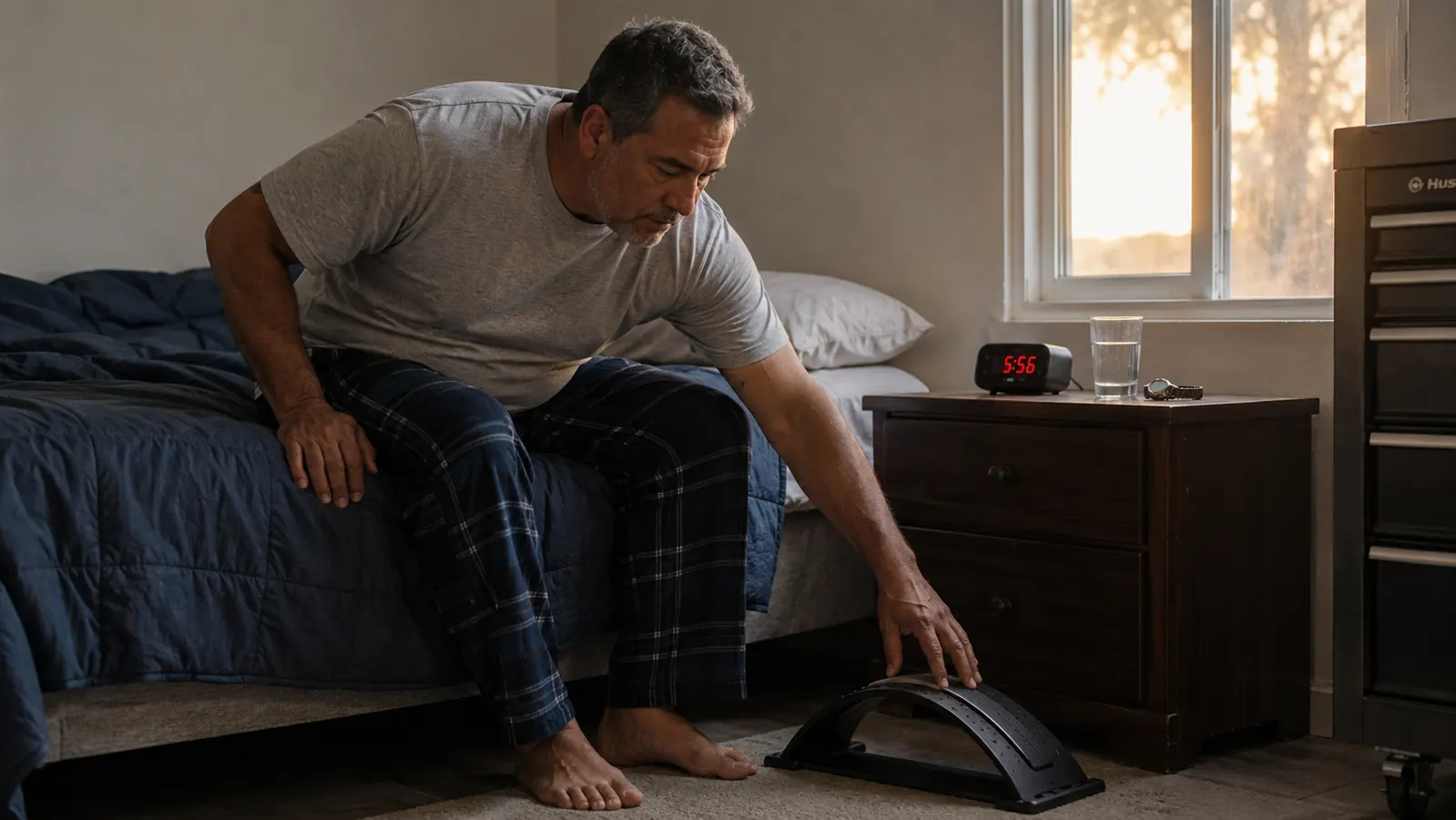
There's a specific kind of morning stiffness that comes from sitting in one position for a living, and it's different from being sore after a workout. I drive Route 14 out of the east depot, twenty-two years now, and for most of those years my alarm would go off and I'd just lie there. Not because I was tired, but because I knew the second I swung my legs off the bed my lower back was going to lock up and I'd have to shuffle to the bathroom bent halfway over like a man twice my age. Connie used to watch me do this little hunched walk every morning and finally told me, half joking, that I moved like I'd slept in a filing cabinet.
What changed it wasn't a doctor visit or a new mattress. It was a cheap plastic back stretcher called the MINOLL, and a routine I built around it that takes less time than making coffee. I'm going to walk you through exactly what I do, step by step, because the order and the timing matter almost as much as the tool itself. Do this wrong and you'll quit after two mornings. Do it in the right order and morning stiffness stops being the worst part of your day.
If your job has you sitting or standing in one position for hours, driving a route, working a nursing floor, running a forklift, the stiffness you wake up with isn't really a sleep problem. It's a job problem that shows up while you sleep. Your body holds the same compressed, hunched shape for eight hours behind the wheel or on your feet, and then it holds a similar curled-up shape for another eight hours in bed. Nothing in that stretch of sixteen or more hours ever asks your spine to arch the other direction. A back stretcher is the one deliberate minute of the day where that finally happens, and that's the whole reason this works as well as it does.
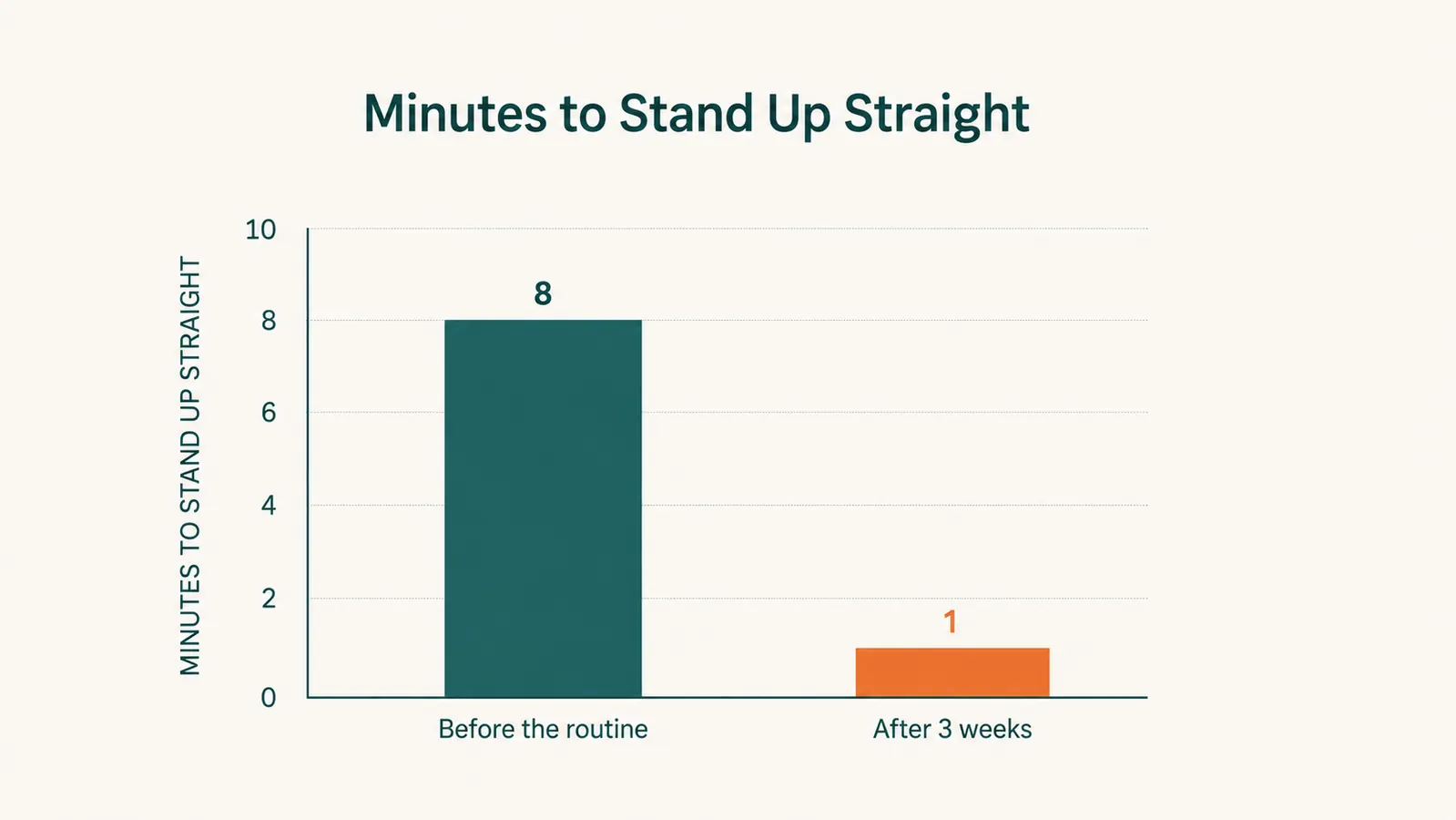
Sick of needing five minutes just to stand up straight?
The MINOLL back stretcher is the tool this whole routine is built around. Adjustable arch levels, no batteries, and it's under thirty dollars at today's price. Grab one before you read the steps below so it's on your floor by tomorrow morning.
Amazon Check Today's Price on Amazon →Step 1: Set the MINOLL back stretcher up the night before
The single biggest mistake I made the first two weeks was keeping the MINOLL in the closet. A tool you have to go dig out at five thirty in the morning is a tool you'll skip the first time you're running late, and everybody's running late at least twice a week. Now I set it on the rug right beside the bed before I go to sleep, arch piece already snapped to whatever level I'm using that week, positioned so I can reach it without even standing up.
This sounds like a small detail but it's the difference between a routine that lasts three months and one that lasts three days. If the back stretcher isn't within arm's reach the moment your feet hit the floor, morning stiffness wins that round before you've even tried to fight it. Connie thought I was being obsessive about it until she noticed I hadn't missed a morning in over a month.
I also learned to keep a small towel folded next to it. Some mornings my lower back is stiffer than others, usually after a longer shift the day before, and a folded towel under my head keeps my neck comfortable while I'm arched over the MINOLL. It's a small thing that costs nothing, but little friction points like an uncomfortable neck are exactly what make people quit a routine in week two instead of sticking with it through month three.
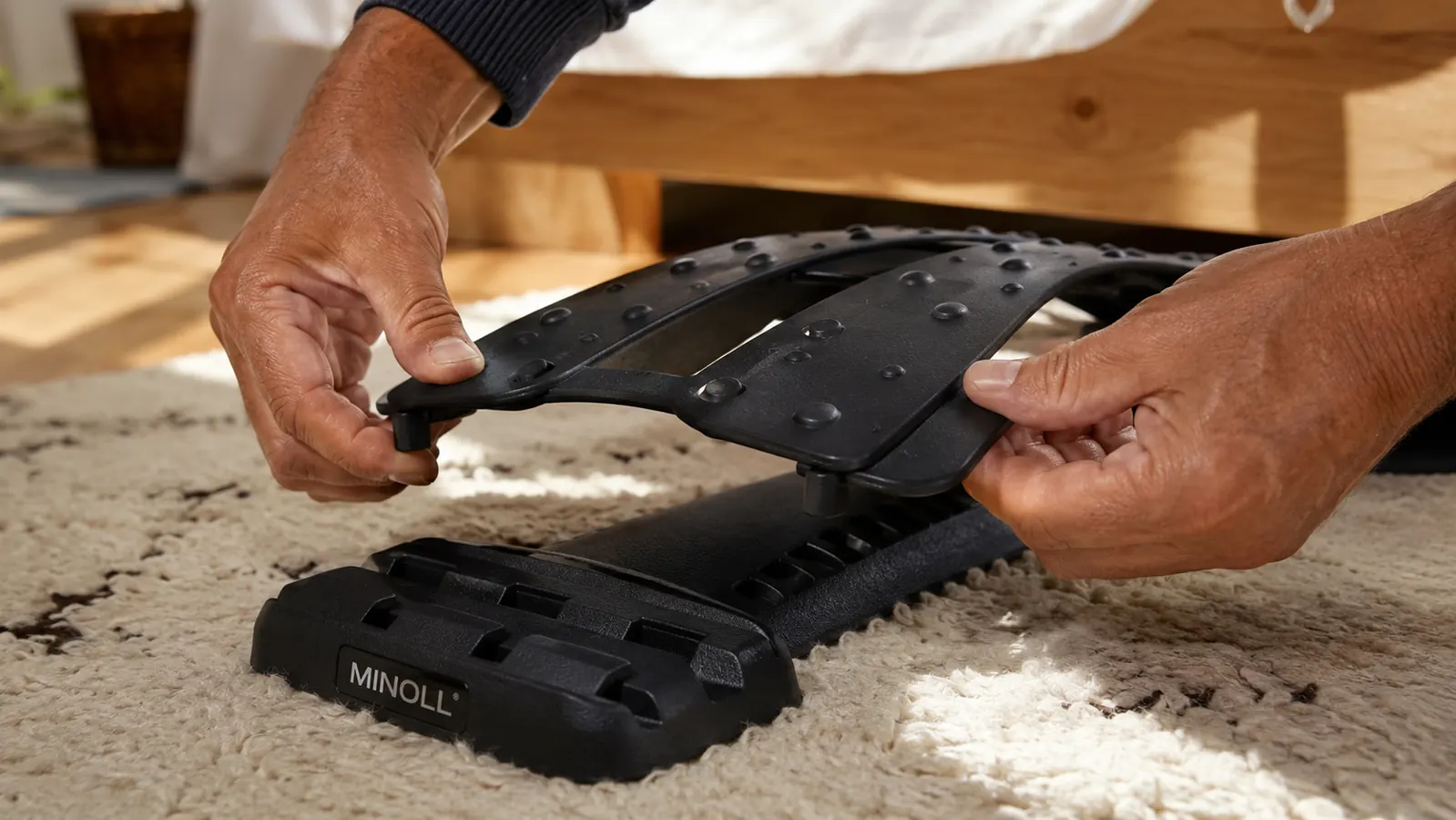
Step 2: Lie back onto it the moment you sit up, before you do anything else
Don't check your phone first. Don't start thinking about the route schedule or what Diesel and Rosie need for their walk. The window right after you wake up, while you're still groggy and haven't started moving around and compensating for the stiffness, is when the back stretcher does the most good. I sit up, turn, and lower myself straight down onto the MINOLL with my lower back centered on the curve, arms stretched back over my head.
If you're new to this, start on the lowest arch level. The MINOLL comes with multiple stackable pieces so you can build the curve up gradually instead of committing to a deep stretch cold, and I mean that as a warning, not a suggestion. I skipped this advice my first morning, went straight to the middle level because I figured a stiff 56-year-old back needed a real stretch right away, and I paid for it with two extra sore days. Start flat. You'll thank yourself in week three when you're ready for more.
Timing matters here too. If you wait until after your shower or after you've already been standing around the kitchen for twenty minutes, your body has started compensating for the stiffness in ways that make the stretch less effective, your muscles guard differently once you've been upright a while. The routine works best as literally the first physical thing you do, before your feet have carried any weight.
Step 3: Hold it for eight to ten minutes and breathe, don't force it
This is where people rush. Two minutes on a back stretcher feels like something, but it isn't enough time for a stiff lower back to actually release. I stay on the MINOLL for a solid eight to ten minutes most mornings, breathing slow, letting gravity pull my spine into that gentle backward arch instead of trying to force the stretch with muscle. I usually pull up the route schedule on my phone while I lie there, since I've got the time anyway.
The urge to push harder or arch deeper is strong once you feel the first bit of relief, but that's exactly when people hurt themselves. The back stretcher is doing the work through gentle sustained decompression, not through you fighting the curve. If it starts to feel sharp instead of stretchy anywhere along your spine, that's your body telling you to drop back a level, not push through.
I set a timer the first couple weeks because I honestly couldn't judge eight minutes lying still first thing in the morning, it felt like twenty. Once the routine became a habit I stopped needing the timer, my body just tells me when the stretch has done its job for the day. Give yourself that timer crutch early on instead of guessing, it keeps you from cutting the session short out of impatience.

Step 4: Add two minutes of gentle movement right after you come off it
The back stretcher loosens the stiffness, but a couple minutes of easy movement right after locks the improvement in before you head to the shower. I do slow knee-to-chest pulls, one leg at a time, while I'm still lying on the floor, then a gentle side-to-side hip rock. Nothing intense, nothing that should feel like exercise. This is the part most guys skip because they're already thinking about the coffee maker, and it's also the part that made the biggest difference for me once I started doing it consistently.
Connie noticed this step mattered more than I expected when I started doing it on the weekends too, after a longer session on the MINOLL. The stiffness that used to creep back by the time I finished my second cup of coffee stopped coming back at all once I added this brief movement window. It's maybe ninety seconds, but skipping it means some of what the back stretcher just released starts tightening back up while you're standing at the sink.
Step 5: Track it loosely and build the arch height over three to four weeks
I started jotting a rough one-to-ten stiffness number on my phone right after getting out of bed, before and after using the MINOLL, just so I wasn't guessing whether this was actually working or if I wanted it to be working. Week one I was averaging a seven most mornings, the kind of stiff where you brace against the nightstand. By week four that same first-thing number had dropped to a three, and it stayed there even on the rare morning I ran out the door without using it.
As the weeks pass and your morning stiffness score comes down, that's your cue to move up an arch level on the MINOLL, not before. I moved up once around week three and again around week six. Rushing this step is how you end up sore and quitting. Patience is genuinely the whole strategy here, more than the device itself.
By week eight I noticed something I hadn't expected, I stopped needing to lean on the bus doorframe to crack my back before my first pickup of the day, a habit I'd had for years without really thinking about it. A regular rider actually asked if my back was doing better, and that's when I knew the routine had changed something real, not just something I wanted to believe was working.
What Else Helps
The back stretcher handles the worst ten minutes of my day, but it's not the only thing keeping morning stiffness from creeping back in. Drinking a full glass of water before bed instead of caffeine late in the shift made a noticeable difference for me, dehydrated muscles seem to stiffen up worse overnight. I also walk Diesel and Rosie first thing after my routine, even just around the block, because a little movement outside in daylight seems to finish what the MINOLL starts. Warehouse guys and nurses I've swapped notes with online say the same combination works for them, the device for the acute stiffness and a few boring lifestyle habits to keep it from piling back up.
I switched my pillow setup too, so my knees are supported when I sleep on my side, which keeps my lower back from curling into the exact hunched position I'm trying to undo every morning. None of that replaces the back stretcher. It's more that the routine works better when the rest of your night sets you up for it instead of working against you. Same goes for the mattress, mine is on the firmer side now, and a softer bed that lets your hips sink lower than your shoulders undoes some of what the morning routine fixes. Footwear during the shift matters too. I replaced my old work shoes once the soles packed down flat, since standing or working the pedals all day in worn-out support undoes some of what the morning routine buys you.
Ten minutes on the floor before coffee beats twenty minutes of shuffling around bent over, hoping my back loosens up on its own.
Twenty-two years of stiff mornings taught me this routine works
The MINOLL back stretcher is the tool every step above is built around. It's cheap, it's quiet, and it's still on my bedroom floor after months of daily use. Check today's price on Amazon and start tomorrow morning.
Amazon Check Today's Price on Amazon →